


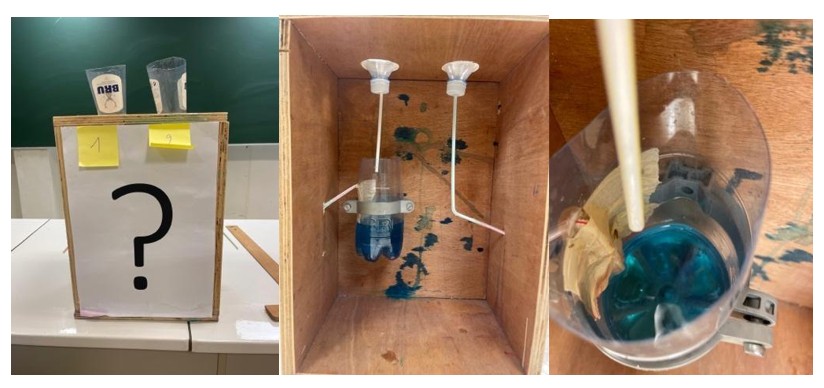
Black Box: Water-making Machine
Students collaboratively propose models to explain the behaviour and design of a black-box device.
Key Focus
Collaboration
Proposing models
Subject(s)
Chemistry
Suitable for age(s)
12-18 years
Introduction
In school science, the focus is often on scientific results and established theories, while less emphasis is placed on how science works—the nature of science (NOS). To address this gap, this task introduces learners to the core processes of scientific inquiry through an engaging “black box” experiment called the water-making machine. Learners are challenged to find patterns, formulate models to explain those patterns, and discuss and compare those models. They are prompted to reflect on how scientific knowledge is constructed and how certainty in science is built not through definitive answers but through iterative model refinement and experimental testing.
This task is based on a black-box activity designed by Lederman (‘the water-making machine’), which helps students understand how models and theories are created in science and how they relate to patterns. Learners try to understand how the water-making machine (a black box) works. They look for patterns using the machine and create models to explain these patterns. These models are then compared and discussed. How confident are they about their model? How can they become more certain of it? After the discussion, they relate this to real scientific work.
Differentiating between patterns and models is a vital skill for scientists. In daily school practice, the distinction between both is not emphasised, leading to confusion between the concepts. It must be clear that patterns are not debated if they are derived from well-conducted experiments. However, finding the correct model is at the core of scientific debate. Often, special experiments must be designed to differentiate between models, as is also done during the task. Within this context, it is noteworthy that there is still ongoing discussion about how to accurately explain or model the siphon phenomenon (Richert, 2012; Wikipedia, 2023). For advanced learners, this discussion can be used to illustrate how real scientists have similar discussions as they did during their activity.
Task Description
In this task, students examine how a black box labelled a water-making machine operates. They pour water into funnels connected to the box and observe the output, looking for patterns in the behaviour. From these observations, they formulate models (hypotheses) about what might be inside the box. Students
- Observe the black box’s behaviour
- Identify patterns in the outputs
- Develop models that explain these patterns
- Discuss and compare different models as a class
- Reflect on how scientists develop and improve knowledge through experimentation and discussion.
No prior scientific knowledge is needed, though familiarity with the siphon principle may emerge and can be introduced during the lesson if needed. [Inside the black box, there is a hidden water reservoir that can be emptied by a siphon.
Materials required
- One opaque box (cardboard or wooden)
- Two plastic bottles (500 ml each), tops removed to create funnels
- Straws or plastic tubing (for siphon mechanism)
- Tape and silicone sealant (for watertight seals)
- Water (optionally colored with food dye)
- Three 500 ml beakers
- Optional: Additional colored water for advanced tests
- Whiteboard or blackboard (for drawing models)
- Markers or chalk
- Paper and pencils (for student sketches)
- Timer (to track water delay if needed)