


Units, Density, and Cartesian Diver
Students investigate relationships between mass, volume, density, and buoyancy with a Cartesian diver
Key Focus
Measurement, Unit Transformation
Subject(s)
Physics
Suitable for age(s)
12-18 years
Introduction
The Cartesian diver is a well-known and visually engaging physics toy that illustrates basic concepts of density and buoyancy. It consists of an object with a bubble of air that changes its volume when pressure is applied. As a result, the diver’s overall density fluctuates. If the diver is designed with a density slightly lower than that of the liquid, it will float normally, but it sinks if the pressure increases. The Cartesian diver is also used as an illustration for the fish with a fish bladder.
This task is based on inquiry-based learning (IBL), progressing through three levels: structured inquiry, guided inquiry, and open inquiry. The introductory section requires only basic technical skills for assembling a diver and is suitable even for primary school students. The same task could be used in lower secondary school, where students are already familiar with simple measurements of mass, time, length, and temperature, to extend the concept of measurement or as motivation for introducing density. Finally, the Cartesian diver is used after buoyancy is explained to test understanding of both concepts—density and buoyancy—and their connection.
Several real-life connections could be discussed, beyond fish and the density of solutions. Ships are made of iron and do not sink; boats are made of wood, so do they sink? How are the capacities of ships determined? The task serves not only as a scientific exploration but also as a social tool to facilitate transitions such as establishing relationships with new teachers and peers, and as an interdisciplinary bridge across physics, chemistry, biology, and mathematics.
Task Description
This rich task is designed to explore how the physical properties of divers affect their ability to float or sink. It introduces the novel property of “floatability” and leads learners through increasingly autonomous investigative steps:
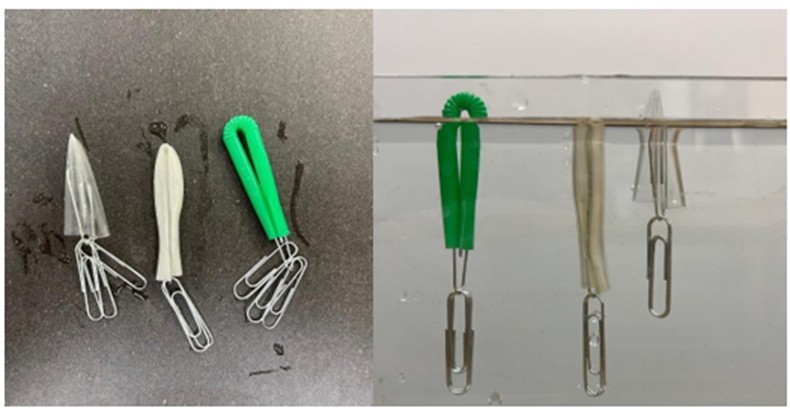
- Part 1 – Structured Inquiry: Students construct simple divers and explore the concept of floatability. The first part introduces the construction of a diver and discusses the “new” property of an object called “floatability”, along with the process used to measure it.
- Part 2 – Guided Inquiry: Learners design experiments to examine which properties affect floatability. The second part studies the dependence of floatability on the properties of an object. It is conducted as a guided inquiry using a poster to control variables.
- Part 3 – Open Inquiry: Students construct a Cartesian diver and explore its behavior under pressure. Finally, the Cartesian diver is constructed, and its properties, behaviour, etc., are studied as part of an open inquiry.
Key concepts addressed include measurement, density, buoyancy, and experimental skills such as designing experiments, predicting outcomes, organising data, drawing conclusions and presenting findings. Additionally, since a diver’s properties influence its floating ability, a teacher can guide students through the transition from comparing properties to measuring and defining a new property called “floatability. ” When analysing how a diver’s properties affect floatability, students realise that basic properties like mass and volume are insufficient to determine when an object will float or sink. This understanding highlights the need for the concept of density. Ultimately, studying how fish swim at various depths offers an engaging interdisciplinary science project.
Materials required
Per student
- 15–20 paperclips
- 2–3 drinking straws with a diameter big enough that a paperclip can be inserted into the straw (or soft transparent plastic tubes).
Per group
- Scissors
- Ruler
- a glass filled with water (at least 15 cm high)
Per class
- Aquarium filled with water (for demonstration)
- Teacher’s set of materials for demos
- Worksheets
- 10 sticky notes per student/group
- A4-sized inquiry posters (students)
- A1-sized demonstration poster (teacher)